Historical ninja were intelligence operatives, not the black-clad supernatural assassins of popular imagination. Japanese academic research — centered at Mie University's International Ninja Research Center, the world's first institution dedicated to ninja studies — has established that shinobi verifiably existed from the 14th century as spies, saboteurs, and mercenary scouts. The three surviving ninjutsu manuals reveal professionals whose core skills were disguise, psychology, pharmacology, and patient information-gathering — operatives closer to modern intelligence agents than to the superhumans of Naruto.
From Rogue Militias to Iga's Self-Governing Republic
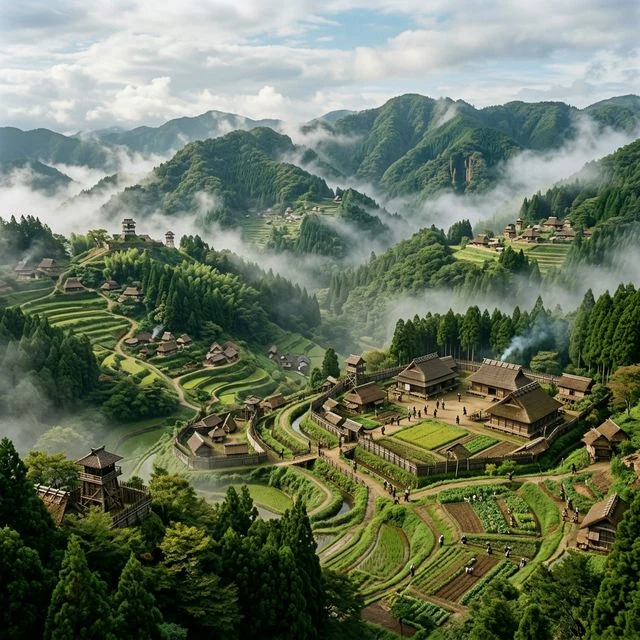
The word shinobi (忍び) appears as early as the 8th-century poetry anthology Man'yōshū, but with the generic meaning of "stealing away" rather than denoting a profession. Professor Yamada Yūji of Mie University traces the emergence of shinobi as a distinct occupational role to the 14th-century Nanbokuchō period (1336–1392). Their predecessors were the akutō — rogue militias that gained influence during the collapse of the Kamakura shogunate.
The Sengoku period (~1467–1615) became the golden age of shinobi activity. Two adjacent mountain regions emerged as centers of expertise: Iga Province (modern Mie Prefecture) and Kōka District in Ōmi Province (modern Shiga Prefecture). In Iga, some 300–500 small estates and roughly 700 fortifications supported a confederation of jizamurai (peasant-warriors) who formed the remarkable Iga Sōkoku Ikki — a self-governing military republic with a written constitution (~1560) based on mutual defense.
"A spy who in times of war enters a castle by night or clandestinely, or infiltrates the enemy ranks to obtain intelligence."
— Vocabulario da Lingoa de Iapam (1603 Jesuit dictionary), defining xinobi
A Jesuit dictionary published in Nagasaki in 1603 defines xinobi as precisely a spy for intelligence — not a supernatural assassin. The word "ninja" (忍者) itself is a modern pronunciation that became standardized only in the mid-20th century, entering English in 1967 through the James Bond film You Only Live Twice.
What the Three Great Ninjutsu Manuals Actually Teach
Bansenshūkai
"All Rivers Merge into the Sea" — 22 chapters synthesizing 49 Iga and Kōka ninjutsu traditions. Emphasizes ethics and correct heart (seishin) above all fighting technique.
Shōninki
"True Ninja Record" — the most psychologically sophisticated of the three. Covers face-reading, information extraction, and the famous six essential tools (Shinobi Rokugu).
Ninpiden
"Secret Traditions of the Ninja" — attributed to the Hattori family. Most practice-focused: lock-picking, infiltration methods, and equipment for field operations.

All three manuals share a crucial emphasis on intelligence-gathering over combat. The Bansenshūkai's central ethical teaching — that ninjutsu must never be used for selfish purposes — fundamentally contradicts the mercenary assassin image. A critical discovery came in June 2022 when a manuscript of the Kanrinseiyō — the legendary source text the Bansenshūkai summarizes — was found at Kazuraki Shrine in Kōka City.
See Real Ninja Tools at the Samurai & Ninja Museum Asakusa
The Samurai Ninja Museum Tokyo with Experience in Asakusa displays authentic replica ninja tools, guides you through the real history, and lets you throw shuriken and train like a shinobi — steps from Sensō-ji Temple.
Hattori Hanzō and the Problem of Legendary Ninja
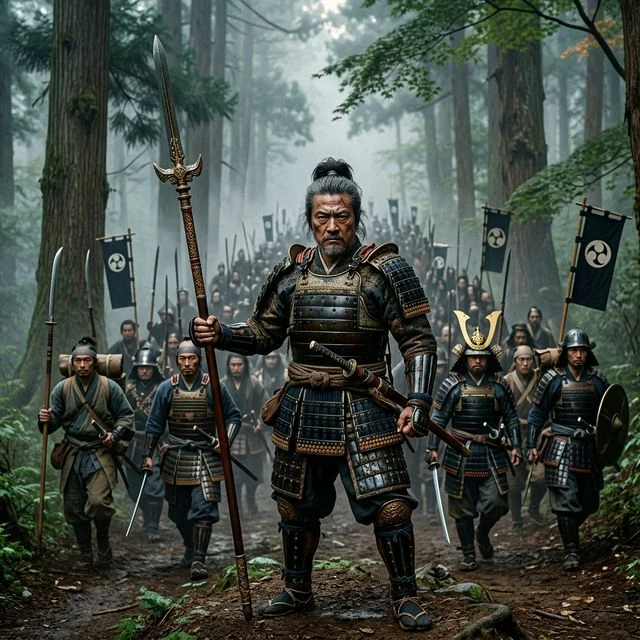
Research by Tamura Risa (2020) demonstrated that Hattori Hanzō was not regarded as a "ninja" until the 20th century. The first linkage of Hanzō to ninjutsu came from Fujita Seiko in 1938 lectures; the first novel to call him an "Iga ninja" was Shiba Ryōtarō's Castle of Owls (1958).
The historical Hattori Masanari (~1542–1596), the second to bear the hereditary name "Hattori Hanzō," was a samurai military commander nicknamed "Oni no Hanzō" (Demon Hanzō) for his spear prowess — not a shadow operative. What is verified: Masanari led 30 Iga shinobi in night harassment of Takeda Shingen's forces at Mikatagahara (1573) and gave his name to Hanzōmon gate at Edo Castle — a name that endures on the Tokyo Metro map today.
Momochi Sandayū is better documented: he maintained three separate households with three different identities — operational security that reads like a modern intelligence protocol. Fujibayashi Nagato remains most enigmatic; many scholars believe he and Momochi were the same person using different identities.
Espionage, Arson, and the Tenshō Iga War
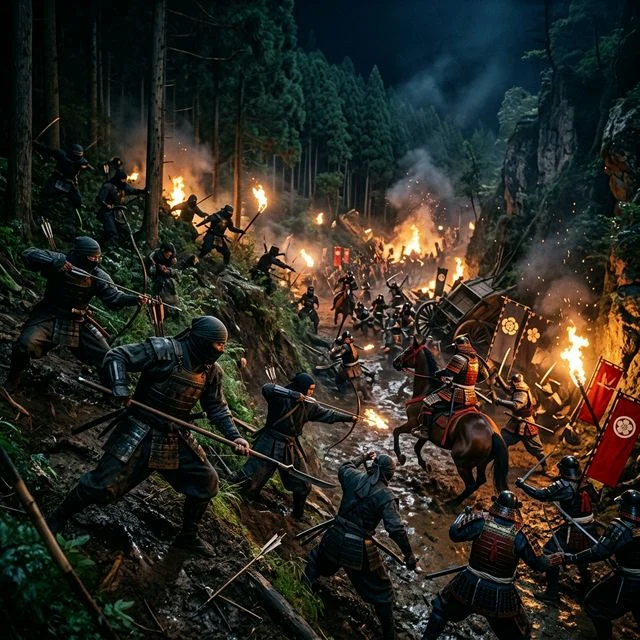
According to Japanese sources, shinobi performed five core functions: espionage (kanchō), reconnaissance (teisatsu), surprise attack (kishū), disruption/agitation (konran), and arson (katon). Professor Yamada states plainly: "The most important role of ninja is to collect intelligence. They tried to avoid fighting as much as possible."
The Tenshō Iga War (1579–1581) represents both the apex and destruction of organized shinobi power. In the First War (1579), Oda Nobukatsu invaded Iga with ~10,000 troops. The Iga jizamurai — numbering roughly 4,000 — used terrain knowledge, guerrilla tactics, and night attacks to decisively rout the invasion. Stephen Turnbull called this "one of the greatest triumphs of unconventional warfare over traditional samurai tactics in the whole of Japanese history."
In the devastating Second War (1581), Nobunaga himself led 40,000–50,000 troops from six directions, implementing scorched-earth strategy. Of Iga's approximately 90,000 inhabitants, an estimated 30,000 or more were killed. The confederacy was annihilated.
The last documented ninja operations occurred during the Shimabara Rebellion (1637–1638). Kōga ninja surveyed fortification plans, measured moat depths, stole enemy passwords, and helped capture outer baileys. After Shimabara, the age of the field operative was over.
Seven Myths Demolished by Japanese Scholarship

The black costume
The Ninja Museum of Igaryu states: "There was no such thing as 'shinobi costume.'" The black-clad image originates entirely from kabuki's kuroko stagehands. Dark navy blue was preferred for night operations — black creates unnatural silhouettes in moonlight.
Shuriken were ninja weapons
Yamada states: "I have not been able to find any record of ninja using shuriken" in any historical handbook. The shuriken association comes entirely from Edo-period theater, not military records.
Ninja vs. samurai opposition
"Ninja" described a role, not a social status. Many ninja were samurai. Hattori Hanzō commanded Iga operatives while holding samurai rank. The binary opposition is a modern pop-culture invention.
Kunoichi (female ninja) combatants
Yamada and Yoshimaru conclude: "There are no historical records of female ninja who conducted reconnaissance and subversive activities." The Bansenshūkai describes using women for kitchen intelligence — not training female warriors.
The ninjatō (straight sword)
Has no physical evidence before the 1900s and is almost certainly a modern invention. Historical ninja used standard weapons; ninjutsu manuals emphasize fire tools, climbing gear, and lock picks over bladed weapons.
Supernatural powers
Shinobi ties to Shugendō mountain asceticism became conflated with magical abilities through literary embellishment. A shinobi completing a seven-day journey in five days likely rode horses.
How Kabuki Stagehands Created the Ninja We Know
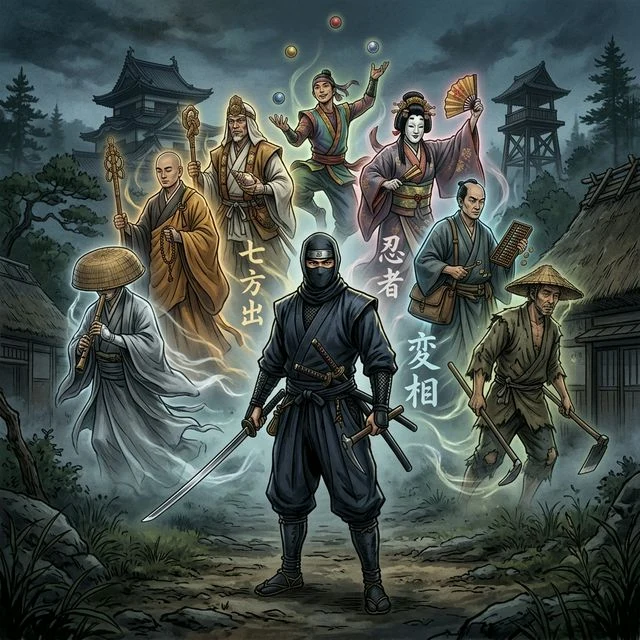
The transformation of shinobi from mundane spies into supernatural cultural icons occurred in distinct waves. The iconic black ninja costume derives directly from the convention of kuroko (黒衣) — kabuki stagehands dressed in black to be "invisible" to audiences. The earliest pictorial reference to a ninja in black dates to 1801. Kabuki also introduced shuriken-throwing and reimagined the legendary bandit Ishikawa Goemon as a ninja.
The decisive transformation arrived in the late 1950s–1960s. Yamada Futarō published 24 ninja novels beginning with Kōga Ninpōchō (1958), giving each ninja a unique pseudo-biological superpower — the conceptual DNA of every ninja manga since. Simultaneously, the Shinobi no Mono film series (1962) established virtually every visual element of pop-culture ninja: black hoods, shuriken, clan wars, kunoichi.
Naruto (1999–2014), with over 250 million copies sold globally, represents the apotheosis of this centuries-long mythologization — a work built on layers of fiction stretching back to Edo-period kabuki.
Mie University and the Academic Revolution in Ninja Studies
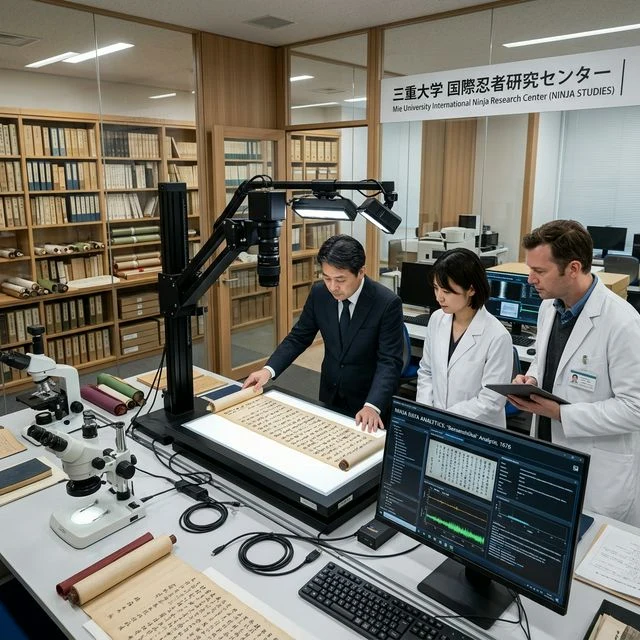
The establishment of the International Ninja Research Center at Mie University in 2017 marked a watershed. Led by Professor Yamada Yūji, the center conducts systematic research including a fire laboratory for testing incendiary recipes from historical manuals, and the peer-reviewed journal Ninja Kenkyū published on J-STAGE. In 2018, Mie University launched the world's first master's degree in ninja studies.
Recent discoveries include: a previously unknown Bansenshūkai manuscript at the Sanada Treasure Museum in Nagano; a ninjutsu document from the U.S. Library of Congress; and in December 2021, a new ninjutsu document discovered in the storehouse of Kuzugi Shrine in Kōka. Iga and Kōka have been jointly designated as Japan Heritage sites under the title "Shinobi-no-Sato Iga and Koka."
British historian Stephen Turnbull published "The Ninja: An Invented Tradition?" (Journal of Global Initiatives, 2014), arguing much of the Iga-Kōka pre-eminence was retrospectively constructed during the Edo period. Yamada takes a more balanced position: while acknowledging mythologization, he emphasizes that Iga and Kōka are the only regions from which ninjutsu manuals survive.
Intelligence Work, Not Sorcery
The real shinobi were products of a specific historical ecology — mountainous terrain, political fragmentation, and a mercenary economy that rewarded information over brute force. Their core competencies were disguise, psychology, pharmacology, meteorology, and patient observation — the skillset of an intelligence operative, not a supernatural warrior.
The ongoing academic revolution at Mie University — with new manuscripts still being discovered in shrine storehouses, castle museums, and foreign libraries — suggests the full historical picture remains incomplete. The real ninja story is still being written, one archival discovery at a time.
Further Reading
- Primary sources in translation: Antony Cummins & Yoshie Minami's translations of the Bansenshūkai (The Book of Ninja, 2013), Shōninki (True Path of the Ninja), and Ninpiden (Secret Traditions of the Shinobi, 2012)
- Japanese academic works: Yamada Yūji, Ninja no Rekishi (KADOKAWA, 2016); Ninja Gaku Kōgi (Chūō Kōron Shinsha, 2020)
- Revisionist Western scholarship: Stephen Turnbull, Ninja: Unmasking the Myth (2017); "The Ninja: An Invented Tradition?" (Journal of Global Initiatives, 2014)
- Online: National Diet Library digital exhibition "NINJA: Fiction and Reality" — authoritative resource with primary source reproductions
- Peer-reviewed research: Ninja Kenkyū (忍者研究) published on J-STAGE by the International Ninja Studies Association
Frequently Asked Questions
Yes, shinobi (ninja) were real, historically documented intelligence operatives active from roughly the 15th century, most famously from the Iga and Kōga regions of today's Mie and Shiga Prefectures. What is largely fiction is the pop-culture image: the all-black suit, supernatural powers, and constant assassinations. Real shinobi worked as spies, scouts, and infiltrators, and Mie University's International Ninja Research Center studies their documented history academically.
Rarely. The black suit is a theatrical convention borrowed from kabuki stagehands. Historical shinobi dressed to blend in: as farmers, merchants, or monks, often in dark navy for night work. Being identifiable as a ninja would have defeated their purpose.
Experience the Real History at the Samurai & Ninja Museum Tokyo
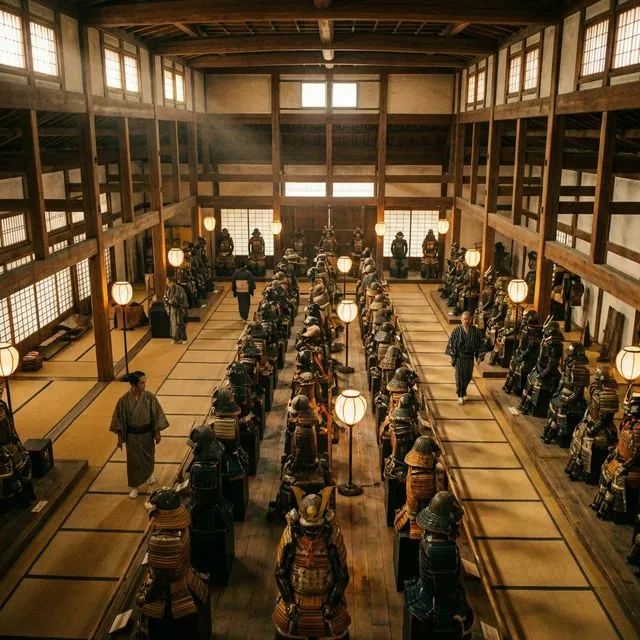
Now that you know the facts, step inside the Samurai Ninja Museum Tokyo with Experience. Throw real shuriken, wear authentic samurai armor, and train with an English-speaking guide, steps from Sensō-ji Temple in Asakusa.